
Quebec Act 16 & Maintenance Log:
what your condo board must know
Act 16 transforms condo management in Quebec. Mandatory maintenance log, strengthened reserve fund, new board responsibilities, here is a clear guide to understand your obligations and comply without stress.
Join early accessWhat is Quebec Act 16?
Adopted in December 2019 by Quebec's National Assembly, Act 16 amends the Civil Code of Quebec to strengthen the governance of divided co-ownerships (condominiums).
Its primary goal: protect co-owners by requiring rigorous, transparent building management and preventing under-funded reserve accounts and deferred maintenance.
Act 16 applies to all divided co-ownership syndicates in Quebec, whether a 4-unit building or a complex of hundreds of condos.
The 3 key obligations of Act 16
1. The Maintenance Log
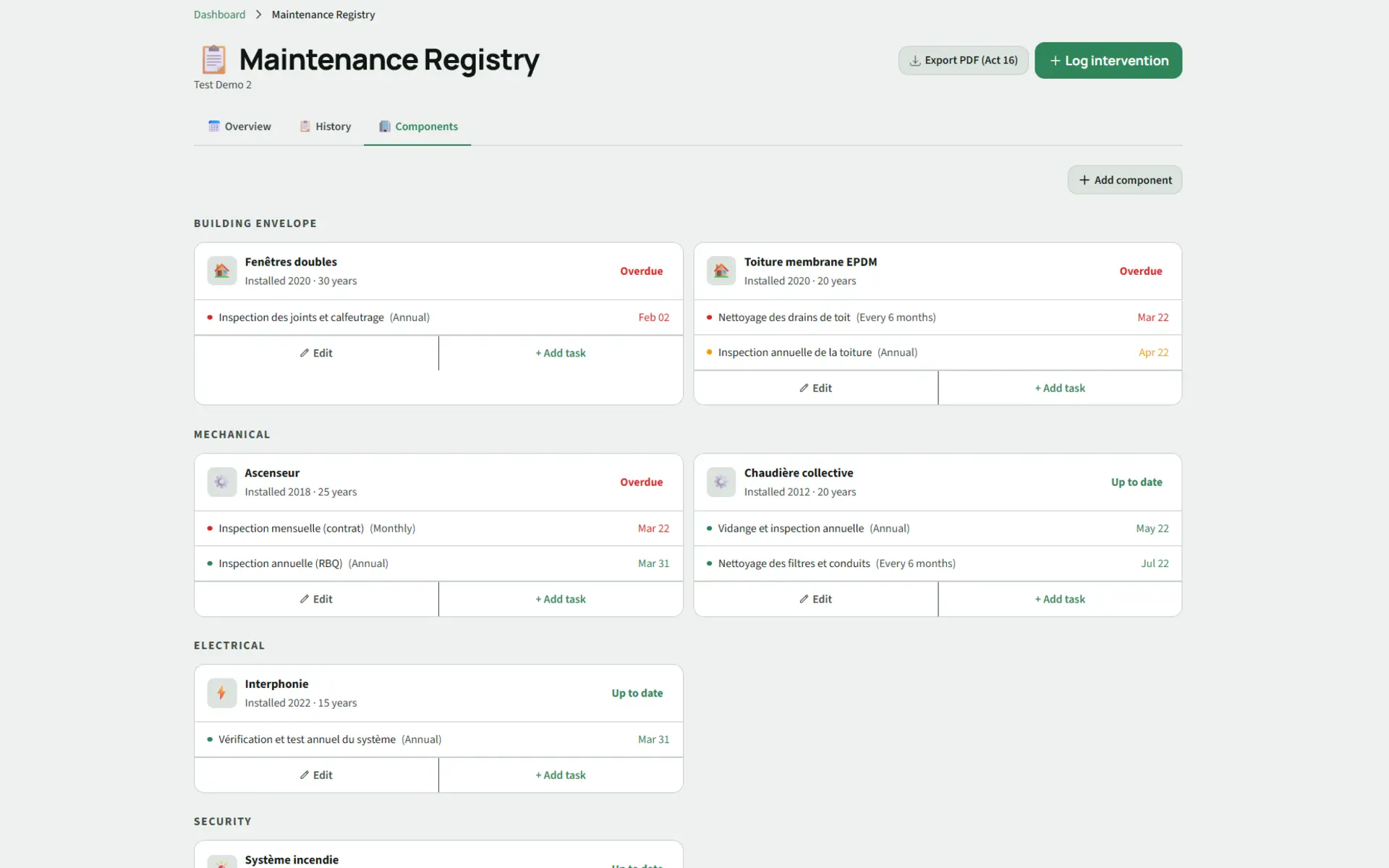
A complete inventory of all building components (roof, plumbing, elevators, etc.) with their condition, estimated useful life and work history.
2. Reserve Fund Study
A professional analysis by a qualified expert (engineer, technologist) every 5 years to determine required reserve fund contributions based on the building's actual condition.
3. Annual Disclosure
The syndicate must provide co-owners with a detailed financial statement including the reserve fund balance, expected contributions, and a maintenance log summary.
The Maintenance Log in Detail
The maintenance log is the most operationally demanding obligation of Act 16. It must be kept current and accessible to co-owners on request.
What must the maintenance log contain?
- A complete inventory of building components: structure, roof, windows, mechanical/electrical/plumbing systems, elevators, common areas, etc.
- The current condition of each component and its installation year
- The remaining useful life estimate of each component
- The maintenance history for each component
- The future maintenance schedule and recommended preventive work
Who is responsible for the maintenance log?
The co-ownership syndicate, represented by its board of directors, is legally responsible for creating, updating and maintaining the log. In practice, this is often managed by the property manager or a designated board member.
What are the consequences of non-compliance?
- Civil liability for directors in case of damage related to undocumented deferred maintenance
- Complications during unit sales (buyers and notaries require the maintenance log)
- Potential regulatory sanctions and lawsuits from co-owners
What exactly must the maintenance log contain?
The regulation states that the maintenance log must cover all common areas of the building. Here are the mandatory items to document, grouped by category.
Structural components
- Foundations and load-bearing structure
- Roof (type, installation date, estimated remaining life)
- Facades and exterior cladding
- Common exterior windows and doors
Mechanical and electrical systems
- Central heating (boiler, heat pumps)
- Common-area plumbing
- Electrical panel and distribution
- Elevators and freight elevators
- Ventilation and air conditioning
Common spaces and equipment
- Indoor and outdoor parking
- Entry halls and corridors
- Common rooms (gym, meeting space)
- Landscaping
For each component, the log must indicate the installation or last replacement date, current condition (good, acceptable, deteriorated), estimated remaining useful life, anticipated replacement cost, and maintenance work performed or planned. This level of detail may sound intimidating, but once the initial inventory is done, annual updates typically take less than an hour for a small building.
Who can write the maintenance log?
Quebec Act 16 does not require a certified professional to write the maintenance log, unlike the reserve fund study, which must be conducted by a technologist, architect, or engineer.
In practice, the syndicate has three options:
- Write it themselves if a board member has the technical skills to assess component condition. Kohabit provides a structured template and pre-defined categories that work for most small condo associations.
- Hire a building inspector for a professional assessment. Typical cost in Quebec: $800 to $2,500 depending on size and complexity. Worth considering if the building is over 20 years old or has incomplete maintenance history.
- Use a property manager who includes this service in their mandate. More expensive monthly but offloads the board entirely.
For a small syndicate of 4 to 12 units, the autonomous approach with a structured tool like Kohabit is usually the most economical and fully compliant with Act 16 requirements.
Concrete example: Act 16 compliance for a 12-unit building
To put numbers on it, here is a typical scenario: a 12-unit syndicate in Montreal, built in 1995, with no external property manager, run by a volunteer board of three. Below is a realistic estimate of the cost of bringing it into Act 16 compliance over the first 12 months.
| Item | Estimated cost | Frequency |
|---|---|---|
| Initial building inspection By a building inspector (BNQ-certified or equivalent) |
$800 to $1,500 | One-time |
| Writing the maintenance log Autonomously with Kohabit (recommended for this profile) |
$0 (internal time ~10h) | One-time + yearly upkeep |
| Reserve fund study By a technologist or engineer registered with a Quebec order |
$2,000 to $3,500 | Every 5 years |
| Raising monthly contributions Per the study's recommendations |
Variable (typically +30 to +80% per unit) | Monthly, ongoing |
| Management tool (Kohabit) 12 units × $2.99 CAD/month |
~$431 per year | Recurring |
| First-year one-time total | ~$3,200 to $5,400 | (excludes contribution increase) |
Spread across 12 units, the initial compliance cost works out to roughly $270 to $450 per unit, or $22 to $38 per unit per month if smoothed over the first year. Over five years (the gap between two reserve fund studies), the total syndicate investment is about $5,000 to $7,000, which is less than the cost of a single major unplanned repair that better planning would have avoided.
The contrast with non-compliance is striking: a syndicate without a log or a study that suddenly discovers the roof needs replacing with no budget can impose a special assessment of $8,000 to $15,000 per unit, payable within months. That is the strongest economic argument for moving on compliance sooner rather than later.
The reserve fund study: what changes
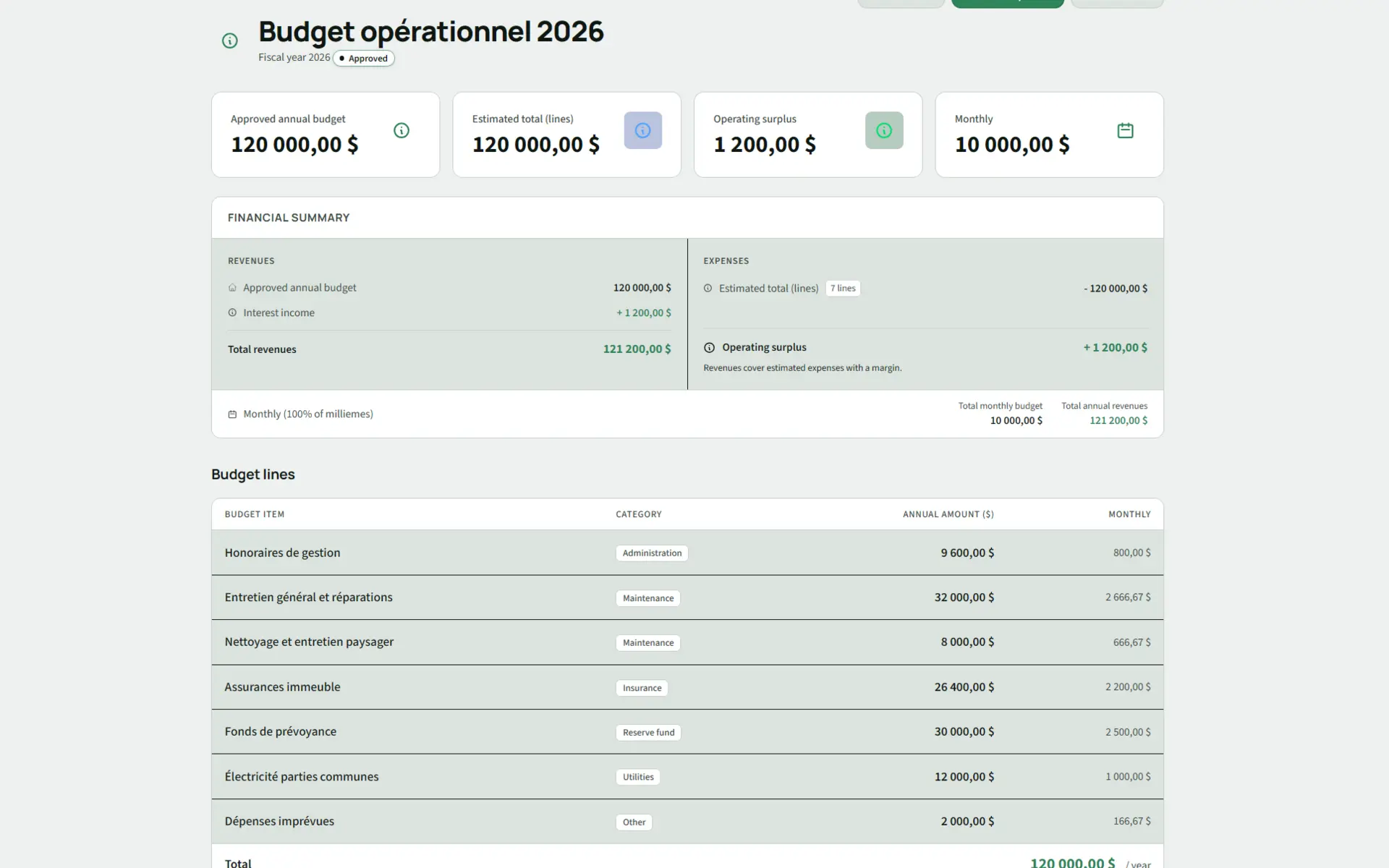
Before Act 16, many syndicates set reserve fund contributions arbitrarily, often too low, leading to brutal special assessments the day a major repair was needed. Act 16 now requires an actuarial reserve fund study conducted by a qualified professional.
How often?
The study must be conducted every 5 years at minimum. It uses the current component condition (from the maintenance log) to project replacement costs over 25 to 30 years.
Who performs it?
Only a professional technologist, architect, or engineer who is a member of a recognized Quebec professional order. Typical cost: $1,500 to $5,000 depending on size.
What if the fund is underfunded?
If the study reveals the fund is insufficient, the syndicate must increase contributions. The longer you wait, the more brutal the increase. That's why acting before 2028 matters.
What buyers and notaries check at sale
Since Act 16 took effect, notaries must verify the syndicate's compliance during any real estate transaction. Informed buyers and their brokers now systematically ask these questions:
- Does the syndicate have an up-to-date maintenance log?
- Has a reserve fund study been completed?
- Is the fund adequately capitalized?
- Does the syndicate provide an annual statement to co-owners?
A non-compliant syndicate can cause sale delays, price reductions, or even block a transaction. Act 16 compliance has become a direct factor in unit resale value. For co-owners planning to sell in the coming years, this is the most tangible argument for fast-tracking compliance.
Act 16 in the broader Canadian context
Quebec is not the only Canadian province to have reformed its condominium framework in recent years. Understanding how Act 16 compares to other provincial regimes helps you measure its ambition and anticipate where regulation is likely heading.
| Province | Governing law | Log / study required? | Update frequency |
|---|---|---|---|
| Quebec | Act 16 (2019), amending the Civil Code | Yes: maintenance log + actuarial study | Study every 5 years |
| British Columbia | Strata Property Act (1998) | Yes: Depreciation Report (equivalent) | Every 3 years |
| Ontario | Condominium Act (1998), Bill 106 (2017) | Yes: reserve fund study | Every 3 years |
| Alberta | Condominium Property Act | Yes: reserve fund study | Every 5 years |
Quebec sits in the Canadian middle of the pack on financial planning obligations. British Columbia and Ontario are slightly stricter on frequency (3 years vs 5 years), but Act 16 goes further on the operational maintenance log, which is less formalized in other provinces. This pan-Canadian trend toward documented, planned condominium management is unlikely to reverse: syndicates that invest in structured tools today are ahead of future regulatory shifts.
For a Quebec syndicate, the question is therefore not how to endure an isolated rule, but how to align with the professional practice that is gradually becoming standard across Canada.
How Kohabit simplifies your Act 16 compliance
Kohabit was designed with Act 16 in mind. Our maintenance log module guides you step by step to create and maintain a compliant registry.
Guided asset inventory
Build your inventory with our step-by-step wizard. Pre-defined categories compliant with Act 16 (structure, mechanical, electrical, etc.).
Maintenance task tracking
Schedule and document every intervention. Automatic reminders for periodic maintenance.
Permanent history
Every intervention is recorded with date, contractor, cost, and attached documents. Nothing is ever lost.
Compliant PDF export
Generate a structured PDF report of your maintenance log for your AGMs, notaries, and archiving.
Act 16 glossary
Condominium law is full of specific terms. Below are definitions of the main concepts used in this page and in official Act 16 documents.
- Divided co-ownership (copropriété divise)
- Ownership regime where each co-owner exclusively owns a private portion (their condo unit) and a share of the common areas (roof, hallways, elevators, etc.). This is the regime Act 16 applies to. Distinct from undivided co-ownership, where no portion is exclusive.
- Syndicate (syndicat de copropriété)
- Legal entity created automatically with the declaration of co-ownership. It groups all co-owners and is responsible for preserving the building. The syndicate is bound by Act 16 obligations, not individual co-owners.
- Maintenance log (carnet d'entretien)
- Living document that lists building components, their condition, useful life, and maintenance history. Required under Act 16, it serves as the reference for the reserve fund study and for real estate transactions.
- Reserve fund (fonds de prévoyance)
- Financial reserve built by co-owners to fund major repairs and replacement of common elements. Distinct from the operating fund, which covers ongoing expenses (insurance, cleaning, etc.).
- Reserve fund study
- Actuarial evaluation conducted by a professional (technologist, engineer, or architect) projecting component replacement costs over 25 to 30 years and setting the required contribution level. Mandatory every 5 years under Act 16.
- Declaration of co-ownership
- Founding notarized deed of the divided co-ownership. Defines common and private portions, the relative value of each fraction (milliemes), and shared living rules. The reference document for any legal question about the building.
- Milliemes (shares)
- Fraction out of 1000 representing a unit's weight in the co-ownership, computed from area, location, and utility. Determines the share of common expenses and voting weight at meetings. Recorded in the declaration of co-ownership.
- Annual general meeting (AGM)
- Yearly meeting of all co-owners where key decisions are made: budget approval, board election, voting on major works. Act 16 strengthened the pre-meeting information obligations.
- Special assessment (cotisation spéciale)
- Exceptional capital call decided by the syndicate to fund an unforeseen expense beyond the reserve fund's capacity. Avoiding this is precisely what Act 16 aims for by requiring rigorous financial planning.
Frequently asked questions about Act 16
Official sources and resources
To go straight to the source, here are the official Quebec references on Act 16 and condominium syndicate obligations.
Civil Code of Quebec, articles 1039 to 1109
Full text of the divided co-ownership provisions on LégisQuébec, the official Quebec legislation portal.
Régie du bâtiment du Québec (RBQ)
Regulatory authority overseeing building inspector certification and building safety in Quebec.
OACAPQ
Organization of Accredited Condo Administrators of Quebec, resources for board member and administrator training.
CondoLégal
Reference resource on divided co-ownership law in Quebec, with case law and Act 16 analysis.
Note: these external links open in a new tab. Kohabit is not affiliated with these organizations.
Go further
Explore our practical guide for Quebec condo boards.
Ready to comply with Act 16?
Early access is available now. Create your maintenance log from day one.
Join early accessNo credit card required · Cancel anytime